Friday, April 6, 2012

geologic periods.

triassic period-
The Triassic began in the wake of the Permian–Triassic extinction event, which left the Earth's biosphere impoverished; it would take well into the middle of the period for life to recover its former diversity. Therapsids and archosaurs were the chief terrestrial vertebrates during this time. A specialized subgroup of archosaurs, dinosaurs, first appeared in the mid-Triassic but did not become dominant until the succeeding Jurassic. The first true mammals also evolved during this period, as well as the first flying vertebrates, the pterosaurs. The vast supercontinent of Pangaea existed until the mid-Triassic, after which it began to gradually rift into two separate landmasses, Laurasia to the north and Gondwana to the south. The global climate during the Triassic was mostly hot and dry, with deserts spanning much of Pangaea's interior. However, the climate shifted and became more humid as Pangaea began to drift apart. The end of the period was marked by yet another major mass extinction, wiping out many groups and allowing dinosaurs to assume dominance in the Jurassic.
jurassic period- 
The Jurassic is a geologic period and system that extends from about 199.6± 0.6 Mya (million years ago) to 145.5± 4 Mya, that is, from the end of the Triassic to the beginning of the Cretaceous. The Jurassic constitutes the middle period of the Mesozoic era, also known as the age of reptiles. The start of the period is marked by the major Triassic–Jurassic extinction event. However, the end of the period did not witness any major extinction event. By the beginning of the Jurassic, the supercontinent Pangaea had begun rifting into two landmasses, Laurasia to the north and Gondwana to the south. This created more coastlines and shifted the continental climate from dry to humid, and many of the arid deserts of the Triassic were replaced by lush rainforests. Dinosaurs dominated the land, and reached their peak in this period as they diversified into a wide variety of groups. The first birds also appeared during the Jurassic, having evolved from a branch of theropod dinosaurs. The oceans were inhabited by marine reptiles such as ichthyosaurs and plesiosaurs, while pterosaurs were the dominant flying vertebrates. Mammals also existed during this time; however, overshadowed by the dinosaurs, they constituted only a small and relatively insignificant part of the biosphere.
cretaceous period- 
The Cretaceous is a geologic period and system from circa 145.5 ± 4 to 65.5 ± 0.3 million years (Ma) ago. In the geologic timescale, the Cretaceous follows the Jurassic period and is followed by the Paleogene period of the Cenozoic era. It is the youngest period of the Mesozoic era, and at 80 million years long, the longest period of the Phanerozoic Eon. The end of the Cretaceous defines the boundary between the Mesozoic and Cenozoic eras. The Cretaceous was a period with a relatively warm climate, resulting in high eustatic sea levels and creating numerous shallow inland seas. These oceans and seas were populated with now extinct marine reptiles, ammonites and rudists, while dinosaurs continued to dominate on land. At the same time, new groups of mammals and birds, as well as flowering plants, appeared. The Cretaceous ended with a large mass extinction, the Cretaceous–Tertiary extinction event, in which many groups, including non-avian dinosaurs, pterosaurs, and large marine reptiles, died out.
 references: http://en.wikipedia.org/wiki/Triassic
http://en.wikipedia.org/wiki/Jurassic
http://en.wikipedia.org/wiki/Cretaceous

Thursday, March 29, 2012

examples of symbiosis.

Predator/Prey- A predator is an organism that eats another organism. The prey is the organism which the predator eats. Some examples of predator and prey are lion and zebra, bear and fish, and fox and rabbit. 
Parasitism- Parasitism is a type of non mutual relationship between organisms of different species where one organism, the parasite, benefits at the expense of the other, the host. 

Mutualism- Mutualism is the way two organisms of different species biologically interact in a relationship in which each individual derives a fitness benefit (i.e., increased or improved reproductive output).
Commensalism- In ecology, commensalism is a class of relationship between two organisms where one organism benefits but the other is neutral (there is no harm or benefit).
 references: http://science.jrank.org/pages/1641/Commensalism.html
http://en.wikipedia.org/wiki/Mutualism_%28biology%29
http://en.wikipedia.org/wiki/Parasitism
http://necsi.edu/projects/evolution/co-evolution/pred-prey/co-evolution_predator.html

food web.

Producers: tree
Primary Consumers: goat, mouse
Secondary Consumers: owl, wildcat, rabbit, snake
Tertiary Consumers: jackal, wildcat, kite, lion
Scavengers: none
Decomposers: none

references: http://www.vtaide.com/png/foodchains.htm

Thursday, March 15, 2012

how geographic distribution can support evolution.

The existence of similar but unrelated species was a puzzle to Darwin. Later, he realized that similar animals in different locations were the product of different lines of evolutionary descent.
For example, the beaver and the capybara are similar species that inhabit similar environments of North America and South America. The South American coypu also shares many characteristics with the North American muskrat.
 references: http://en.wikipedia.org/wiki/Evolution
http://wiki.answers.com/Q/What_is_Geographical_distribution

Thursday, March 1, 2012

natural selection.

Natural selection is a normal process resulting in the evolution of organisms best adapted to the environment. The relation between Natural Selection and Mutations are very simple. Let's say a Giraffe has a small neck and his food is on a tree. It will cause him to keep reaching as far as he can, if the giraffe and its future generations continue to do this process, their necks will start to extend due to evolution which can affect the phenotypes of the Giraffes which will change the genotypes of the future generations so they will be able to have long necks.
 
Expatation is the shift in a function of a trait during evolution. Like, a trait can evolve because of one function, but subsequently it may come to serve another.

references:  www.unknownworlds.com/ns/
evolution.berkeley.edu/evolibrary/article/evo_25
en.wikipedia.org/wiki/Exaptation 

Thursday, February 16, 2012

cloning questions.

What are some of the social challenges a cloned child might face?
A cloned child may encounter a lot of negativity. They might get bullied, whether verbally or non-verbally. The cloned child may be an outcast. Other people will tease and talk about them a lot. People will tease them about lacking originality and how they are cloned. People who disapprove of cloning greatly may abuse the cloned child, so the cloned child's life could be at risk too.

Should cloning research be regulated? How, and by whom? (extra credit)
Cloning research should not be regulated. We should continue researching cloning that will benefit our society. Research on cloning plants, etc is acceptable because that could benefit our agriculture market. Research on cloning humans, etc should be regulated. The country should ban research on cloning and give consequences to whoever disobeys the law.

references: http://learn.genetics.utah.edu/content/tech/cloning/whatiscloning/

different types of mutations.

Sense Mutation: a single substitution mutation when the change in the DNA base sequence results in a new codon still coding for the same amino acid 

Non-sense Mutation: a codon that stands for an amino acid mutates to one of these three stop codons. Nonsense mutations cause the protein to be cut off early and therefore incomplete, which usually renders it non-functional.

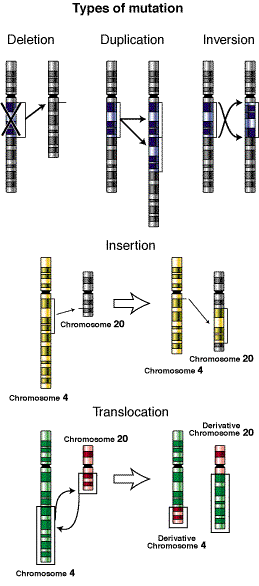
Deletion Mutation: A type of gene mutation wherein the deletion (as well as addition) of (a number of) nucleotide(s) causes a shift in the reading frame of the codons in the mRNA, thus, may eventually lead to the alteration in the amino acid sequence at protein translation

Insertion Mutation: A type of mutation resulting from the addition of extra nucleotides in a DNA sequence or chromosome. Insertion of a larger segment into the chromosome can also lead to mutation. It results when an unequal crossover happens during meiosis. 

Frameshift Mutation: A mutation seen when a number of DNA nucleotides not divisible by three is added or deleted. This causes a reading frame shift and all of the codons and all of the amino acids after that mutation are usually wrong. 

Point Mutation:  A mutation in DNA or RNA molecule involving a change of only one nucleotide base. It is a simple change in one base of the gene sequence.

Translocation Mutation: Translocations are the transfer of a piece of one chromosome to a nonhomologous chromosome. Translocations are often reciprocal; that is, the two nonhomologues swap segments. 

 references: http://www.biology-online.org http://users.rcn.com/jkimball.ma.ultranet/BiologyPages/M/Mutations.html http://www.genetichealth.com/g101_changes_in_dna.shtml

Thursday, February 2, 2012

transcription, translation

Transcription: Transcription is the process of creating a complementary RNA copy of a sequence of DNA. Both RNA and DNA are nucleic acids, which use base pairs of nucleotides as a complementary language that can be converted back and forth from DNA to RNA by the action of the correct enzymes. During transcription, a DNA sequence is read by an RNA polymerase, which produces a complementary, antiparallel RNA strand. As opposed to DNA replication, transcription results in an RNA complement that includes uracil (U) in all instances where thymine (T) would have occurred in a DNA complement.
Translation:  In molecular biology and genetics, translation is the third stage of protein biosynthesis (part of the overall process of gene expression). In translation, messenger RNA (mRNA) produced by transcription is decoded by the ribosome to produce a specific amino acid chain, or polypeptide, that will later fold into an active protein. In Bacteria, translation occurs in the cell's cytoplasm, where the large and small subunits of the ribosome are located, and bind to the mRNA. In Eukaryotes, translation occurs across the membrane of the endoplasmic reticulum in a process called vectorial synthesis. The ribosome facilitates decoding by inducing the binding of tRNAs with complementary anticodon sequences to that of the mRNA. The tRNAs carry specific amino acids that are chained together into a polypeptide as the mRNA passes through and is "read" by the ribosome in a fashion reminiscent to that of a stock ticker and ticker tape.

references: http://en.wikipedia.org/wiki/Translation_%28biology%29
http://en.wikipedia.org/wiki/Transcription_%28genetics%29

name that gene.

Gene 1: Huntingtin is a disease gene linked to Huntington's disease, a neurodegenerative disorder characterized by loss of striatal neurons. This is thought to be caused by an expanded, unstable trinucleotide repeat in the huntingtin gene, which translates as a polyglutamine repeat in the protein product. A fairly broad range in the number of trinucleotide repeats has been identified in normal controls, and repeat numbers in excess of 40 have been described as pathological. The huntingtin locus is large, spanning 180 kb and consisting of 67 exons. The huntingtin gene is widely expressed and is required for normal development. It is expressed as 2 alternatively polyadenylated forms displaying different relative abundance in various fetal and adult tissues. The larger transcript is approximately 13.7 kb and is expressed predominantly in adult and fetal brain whereas the smaller transcript of approximately 10.3 kb is more widely expressed. The genetic defect leading to Huntington's disease may not necessarily eliminate transcription, but may confer a new property on the mRNA or alter the function of the protein. One candidate is the huntingtin-associated protein-1, highly expressed in brain, which has increased affinity for huntingtin protein with expanded polyglutamine repeats. This gene contains an upstream open reading frame in the 5' UTR that inhibits expression of the huntingtin gene product through translational repression.
Gene 2: This gene encodes a protein that is one of the two components of elastic fibers. The encoded protein is rich in hydrophobic amino acids such as glycine and proline, which form mobile hydrophobic regions bounded by crosslinks between lysine residues. Deletions and mutations in this gene are associated with supravalvular aortic stenosis (SVAS) and autosomal dominant cutis laxa. Multiple transcript variants encoding different isoforms have been found for this gene.
Gene3: Alzheimer's disease (AD) patients with an inherited form of the disease carry mutations in the presenilin proteins (PSEN1 or PSEN2) or the amyloid precursor protein (APP). These disease-linked mutations result in increased production of the longer form of amyloid-beta (main component of amyloid deposits found in AD brains). Presenilins are postulated to regulate APP processing through their effects on gamma-secretase, an enzyme that cleaves APP. Also, it is thought that the presenilins are involved in the cleavage of the Notch receptor such that, they either directly regulate gamma-secretase activity, or themselves act are protease enzymes. Two alternatively spliced transcript variants encoding different isoforms of PSEN2 have been identified.
Gene4:  Cystic fibrosis is a disease passed down through families that causes thick, sticky mucus to build up in the lungs, digestive tract, and other areas of the body. It is one of the most common chronic lung diseases in children and young adults. It is a life-threatening disorder.
Gene5:  This gene encodes a member of the fibrillin family. The encoded protein is a large, extracellular matrix glycoprotein that serve as a structural component of 10-12 nm calcium-binding microfibrils. These microfibrils provide force bearing structural support in elastic and nonelastic connective tissue throughout the body. Mutations in this gene are associated with Marfan syndrome, isolated ectopia lentis, autosomal dominant Weill-Marchesani syndrome, MASS syndrome, and Shprintzen-Goldberg craniosynostosis syndrome.
Gene6:  The protein encoded by this gene is a negative regulator of the cell cycle and was the first tumor suppressor gene found. The encoded protein also stabilizes constitutive heterochromatin to maintain the overall chromatin structure. The active, hypophosphorylated form of the protein binds transcription factor E2F1. Defects in this gene are a cause of childhood cancer retinoblastoma (RB), bladder cancer, and osteogenic sarcoma.
Gene7:  ATP7A is important for regulating copper levels in the body. This protein is found in most tissues, but it is absent from the liver. In the small intestine, the ATP7A protein helps control the absorption of copper from food. In other organs and tissues, the ATP7A protein has a dual role and shuttles between two locations within the cell. The protein normally resides in a cell structure called the Golgi apparatus, which modifies and transports newly produced enzymes and other proteins. Here, the ATP7A protein supplies copper to certain enzymes that are critical for the structure and function of bone, skin, hair, blood vessels, and the nervous system. If copper levels in the cell environment are elevated, however, the ATP7A protein moves to the cell membrane and eliminates excess copper from the cell.
Gene8:  The dystrophin gene is the largest gene found in nature, measuring 2.4 Mb. The gene was identified through a positional cloning approach, targeted at the isolation of the gene responsible for Duchenne (DMD) and Becker (BMD) Muscular Dystrophies. DMD is a recessive, fatal, X-linked disorder occurring at a frequency of about 1 in 3,500 new-born males. BMD is a milder allelic form. In general, DMD patients carry mutations which cause premature translation termination (nonsense or frame shift mutations), while in BMD patients dystrophin is reduced either in molecular weight (derived from in-frame deletions) or in expression level. The dystrophin gene is highly complex, containing at least eight independent, tissue-specific promoters and two polyA-addition sites. Furthermore, dystrophin RNA is differentially spliced, producing a range of different transcripts, encoding a large set of protein isoforms. Dystrophin (as encoded by the Dp427 transcripts) is a large, rod-like cytoskeletal protein which is found at the inner surface of muscle fibers. Dystrophin is part of the dystrophin-glycoprotein complex (DGC), which bridges the inner cytoskeleton (F-actin) and the extra-cellular matrix.

references: http://blast.ncbi.nlm.nih.gov/Blast.cgi?PROGRAM=blastn&BLAST_PROGRAMS=megaBlast&PAGE_TYPE=BlastSearch&SHOW_DEFAULTS=on&LINK_LOC=blasthome
http://www.biologycorner.com/worksheets/name_that_gene.html

Saturday, January 21, 2012

pond water.

Use arrows to identify the microbes in the pond. You only need to pick 5 microbes on the picture, write their common names or phylum (group)
What is its size?

Where are they usually found in the pond?
Describe one feature that makes them interesting.
Although they are common, thy are usually not found in pound samples because they are towards the bottom of the pound.

how chlorophyll helps plants make sugar.

Photosynthesis is the process by which plant life converts solar energy into high energy-yielding molecules to be used by the cells as needed. Chlorophyll plays a primary role in this process. Chlorophyll is the green pigment found most plentiful inside the leaves of plants. It is located within chloroplasts, where photosynthesis takes place. Chlorophyll absorbs light and the energy from the light is transferred directly to the electrons in the chlorophyll molecule. The energy levels of these electrons are raised. The high energy level electrons enable the plants to use low energy raw materials to produce high energy sugars.

fermentation recipe.

Timeframe: 1-4 weeks (or more)
Special Equipment:
  • Ceramic crock or food-grade plastic bucket, one-gallon capacity or greater
  • Plate that fits inside crock or bucket
  • One-gallon jug filled with water (or a scrubbed and boiled rock)
  • Cloth cover (like a pillowcase or towel)
Ingredients (for 1 gallon):
  • 2.2680 kg cabbage
  • 0.18 cup sea salt
Process:
  1. Chop or grate cabbage, finely or coarsely, with or without hearts, however you like it. I love to mix green and red cabbage to end up with bright pink kraut. Place cabbage in a large bowl as you chop it.
  2. Sprinkle salt on the cabbage as you go. The salt pulls water out of the cabbage (through osmosis), and this creates the brine in which the cabbage can ferment and sour without rotting. The salt also has the effect of keeping the cabbage crunchy, by inhibiting organisms and enzymes that soften it. 3 tablespoons of salt is a rough guideline for 5 pounds of cabbage. I never measure the salt; I just shake some on after I chop up each cabbage. I use more salt in summer, less in winter.
  3. Add other vegetables. Grate carrots for a coleslaw-like kraut. Other vegetables I’ve added include onions, garlic, seaweed, greens, Brussels sprouts, small whole heads of cabbage, turnips, beets, and burdock roots. You can also add fruits (apples, whole or sliced, are classic), and herbs and spices (caraway seeds, dill seeds, celery seeds, and juniper berries are classic, but anything you like will work). Experiment.
  4. Mix ingredients together and pack into crock. Pack just a bit into the crock at a time and tamp it down hard using your fists or any (other) sturdy kitchen implement. The tamping packs the kraut tight in the crock and helps force water out of the cabbage.
  5. 5. Cover kraut with a plate or some other lid that fits snugly inside the crock. Place a clean weight (a glass jug filled with water) on the cover. This weight is to force water out of the cabbage and then keep the cabbage submerged under the brine. Cover the whole thing with a cloth to keep dust and flies out.
  6. Press down on the weight to add pressure to the cabbage and help force water out of it. Continue doing this periodically (as often as you think of it, every few hours), until the brine rises above the cover. This can take up to about 24 hours, as the salt draws water out of the cabbage slowly. Some cabbage, particularly if it is old, simply contains less water. If the brine does not rise above the plate level by the next day, add enough salt water to bring the brine level above the plate. Add about a teaspoon of salt to a cup of water and stir until it’s completely dissolved.
  7. Leave the crock to ferment. I generally store the crock in an unobtrusive corner of the kitchen where I won’t forget about it, but where it won’t be in anybody’s way. You could also store it in a cool basement if you want a slower fermentation that will preserve for longer.
  8. Check the kraut every day or two. The volume reduces as the fermentation proceeds. Sometimes mold appears on the surface. Many books refer to this mold as “scum,” but I prefer to think of it as a bloom. Skim what you can off of the surface; it will break up and you will probably not be able to remove all of it. Don’t worry about this. It’s just a surface phenomenon, a result of contact with the air. The kraut itself is under the anaerobic protection of the brine. Rinse off the plate and the weight. Taste the kraut. Generally it starts to be tangy after a few days, and the taste gets stronger as time passes. In the cool temperatures of a cellar in winter, kraut can keep improving for months and months. In the summer or in a heated room, its life cycle is more rapid. Eventually it becomes soft and the flavor turns less pleasant.
  9. Enjoy. I generally scoop out a bowl- or jarful at a time and keep it in the fridge. I start when the kraut is young and enjoy its evolving flavor over the course of a few weeks. Try the sauerkraut juice that will be left in the bowl after the kraut is eaten. Sauerkraut juice is a rare delicacy and unparalleled digestive tonic. Each time you scoop some kraut out of the crock, you have to repack it carefully. Make sure the kraut is packed tight in the crock, the surface is level, and the cover and weight are clean. Sometimes brine evaporates, so if the kraut is not submerged below brine just add salted water as necessary. Some people preserve kraut by canning and heat-processing it. This can be done; but so much of the power of sauerkraut is its aliveness that I wonder: Why kill it?
  10. Develop a rhythm. I try to start a new batch before the previous batch runs out. I remove the remaining kraut from the crock, repack it with fresh salted cabbage, then pour the old kraut and its juices over the new kraut. This gives the new batch a boost with an active culture starter. 

How Fermentation Cooks Food:

The critical ingredients for the fermentation process are:

Salt (sea salt)
Lack of oxygen
Cool temperature

Salting the food preserves the food and protects it from bacteria, so it doesn't spoil before it ferments ( use sea salt). Once the food is salted it needs to be kept in a cool place with minimal oxygen. Fermentation involves the breaking down of complex organic substances into simpler ones. The electrons are then passed to an organic molecule such as pyruvic acid. This results in the formation of a waste product that is excreted from the cell. Waste products formed , the substances vital to our utilization of fermentation. During lactic acid fermentation, the electrons released during glycolysis are passed to pyruvic acid to form two molecules of lactic acid. Fermentation preserves food because the bacterial growth reduces the pH of the food to a range where pathogenic and many spoilage organisms won't grow.

Friday, January 20, 2012

osmosis jones.

How is the movie OSMOSIS JONES like your immune system?
- the animated film Osmosis Jones will find entertaining. However, the conversion of the immune system in a simple bacteria-busting COP is really an understatement. It would be better if antibody were treated as heroes (or heroines), because they constantly fight bacteria, viruses and micro-organisms to ensure that all systems of the body functioning at its peak. Without your healthy white blood cells, there is a chance that even the simple cold virus can be murder.

Similarities
-Osmosis Jones is like the blood cells in our body.  When viruses/ diseases come in, white blood cells are the ones that come to fend them off.
-The brain; or "mayor of the city" is the control system which alert the entire body. Their T.v. network is like your nerves that send signals to the entire body and tells it what is happening, it informs the cells to take action and kill the virus.
-the movie shows how the body takes action when something is detected in the body. when the egg was eaten or the oyster, the body tried to get rid of it by its defense. in this case, it was vomit and saliva came to get rid of the germs from the egg.

Differences 
-It is different because i don't think there would a city where the people; "cells" have their own personalities because cells do what they are assigned to. Also, i think the fact that there is only one virus is different.
-The situations in the movie are different from those in our real lives because our immune system cells are not shaped like humans, and neither are the rest of our cells
-There are no bacteria in our body holding parties and conferences, and our immune systems do not shoot down invaders