Friday, April 6, 2012

geologic periods.

triassic period-
The Triassic began in the wake of the Permian–Triassic extinction event, which left the Earth's biosphere impoverished; it would take well into the middle of the period for life to recover its former diversity. Therapsids and archosaurs were the chief terrestrial vertebrates during this time. A specialized subgroup of archosaurs, dinosaurs, first appeared in the mid-Triassic but did not become dominant until the succeeding Jurassic. The first true mammals also evolved during this period, as well as the first flying vertebrates, the pterosaurs. The vast supercontinent of Pangaea existed until the mid-Triassic, after which it began to gradually rift into two separate landmasses, Laurasia to the north and Gondwana to the south. The global climate during the Triassic was mostly hot and dry, with deserts spanning much of Pangaea's interior. However, the climate shifted and became more humid as Pangaea began to drift apart. The end of the period was marked by yet another major mass extinction, wiping out many groups and allowing dinosaurs to assume dominance in the Jurassic.
jurassic period- 
The Jurassic is a geologic period and system that extends from about 199.6± 0.6 Mya (million years ago) to 145.5± 4 Mya, that is, from the end of the Triassic to the beginning of the Cretaceous. The Jurassic constitutes the middle period of the Mesozoic era, also known as the age of reptiles. The start of the period is marked by the major Triassic–Jurassic extinction event. However, the end of the period did not witness any major extinction event. By the beginning of the Jurassic, the supercontinent Pangaea had begun rifting into two landmasses, Laurasia to the north and Gondwana to the south. This created more coastlines and shifted the continental climate from dry to humid, and many of the arid deserts of the Triassic were replaced by lush rainforests. Dinosaurs dominated the land, and reached their peak in this period as they diversified into a wide variety of groups. The first birds also appeared during the Jurassic, having evolved from a branch of theropod dinosaurs. The oceans were inhabited by marine reptiles such as ichthyosaurs and plesiosaurs, while pterosaurs were the dominant flying vertebrates. Mammals also existed during this time; however, overshadowed by the dinosaurs, they constituted only a small and relatively insignificant part of the biosphere.
cretaceous period- 
The Cretaceous is a geologic period and system from circa 145.5 ± 4 to 65.5 ± 0.3 million years (Ma) ago. In the geologic timescale, the Cretaceous follows the Jurassic period and is followed by the Paleogene period of the Cenozoic era. It is the youngest period of the Mesozoic era, and at 80 million years long, the longest period of the Phanerozoic Eon. The end of the Cretaceous defines the boundary between the Mesozoic and Cenozoic eras. The Cretaceous was a period with a relatively warm climate, resulting in high eustatic sea levels and creating numerous shallow inland seas. These oceans and seas were populated with now extinct marine reptiles, ammonites and rudists, while dinosaurs continued to dominate on land. At the same time, new groups of mammals and birds, as well as flowering plants, appeared. The Cretaceous ended with a large mass extinction, the Cretaceous–Tertiary extinction event, in which many groups, including non-avian dinosaurs, pterosaurs, and large marine reptiles, died out.
 references: http://en.wikipedia.org/wiki/Triassic
http://en.wikipedia.org/wiki/Jurassic
http://en.wikipedia.org/wiki/Cretaceous

Thursday, March 29, 2012

examples of symbiosis.

Predator/Prey- A predator is an organism that eats another organism. The prey is the organism which the predator eats. Some examples of predator and prey are lion and zebra, bear and fish, and fox and rabbit. 
Parasitism- Parasitism is a type of non mutual relationship between organisms of different species where one organism, the parasite, benefits at the expense of the other, the host. 

Mutualism- Mutualism is the way two organisms of different species biologically interact in a relationship in which each individual derives a fitness benefit (i.e., increased or improved reproductive output).
Commensalism- In ecology, commensalism is a class of relationship between two organisms where one organism benefits but the other is neutral (there is no harm or benefit).
 references: http://science.jrank.org/pages/1641/Commensalism.html
http://en.wikipedia.org/wiki/Mutualism_%28biology%29
http://en.wikipedia.org/wiki/Parasitism
http://necsi.edu/projects/evolution/co-evolution/pred-prey/co-evolution_predator.html

food web.

Producers: tree
Primary Consumers: goat, mouse
Secondary Consumers: owl, wildcat, rabbit, snake
Tertiary Consumers: jackal, wildcat, kite, lion
Scavengers: none
Decomposers: none

references: http://www.vtaide.com/png/foodchains.htm

Thursday, March 15, 2012

how geographic distribution can support evolution.

The existence of similar but unrelated species was a puzzle to Darwin. Later, he realized that similar animals in different locations were the product of different lines of evolutionary descent.
For example, the beaver and the capybara are similar species that inhabit similar environments of North America and South America. The South American coypu also shares many characteristics with the North American muskrat.
 references: http://en.wikipedia.org/wiki/Evolution
http://wiki.answers.com/Q/What_is_Geographical_distribution

Thursday, March 1, 2012

natural selection.

Natural selection is a normal process resulting in the evolution of organisms best adapted to the environment. The relation between Natural Selection and Mutations are very simple. Let's say a Giraffe has a small neck and his food is on a tree. It will cause him to keep reaching as far as he can, if the giraffe and its future generations continue to do this process, their necks will start to extend due to evolution which can affect the phenotypes of the Giraffes which will change the genotypes of the future generations so they will be able to have long necks.
 
Expatation is the shift in a function of a trait during evolution. Like, a trait can evolve because of one function, but subsequently it may come to serve another.

references:  www.unknownworlds.com/ns/
evolution.berkeley.edu/evolibrary/article/evo_25
en.wikipedia.org/wiki/Exaptation 

Thursday, February 16, 2012

cloning questions.

What are some of the social challenges a cloned child might face?
A cloned child may encounter a lot of negativity. They might get bullied, whether verbally or non-verbally. The cloned child may be an outcast. Other people will tease and talk about them a lot. People will tease them about lacking originality and how they are cloned. People who disapprove of cloning greatly may abuse the cloned child, so the cloned child's life could be at risk too.

Should cloning research be regulated? How, and by whom? (extra credit)
Cloning research should not be regulated. We should continue researching cloning that will benefit our society. Research on cloning plants, etc is acceptable because that could benefit our agriculture market. Research on cloning humans, etc should be regulated. The country should ban research on cloning and give consequences to whoever disobeys the law.

references: http://learn.genetics.utah.edu/content/tech/cloning/whatiscloning/

different types of mutations.

Sense Mutation: a single substitution mutation when the change in the DNA base sequence results in a new codon still coding for the same amino acid 

Non-sense Mutation: a codon that stands for an amino acid mutates to one of these three stop codons. Nonsense mutations cause the protein to be cut off early and therefore incomplete, which usually renders it non-functional.

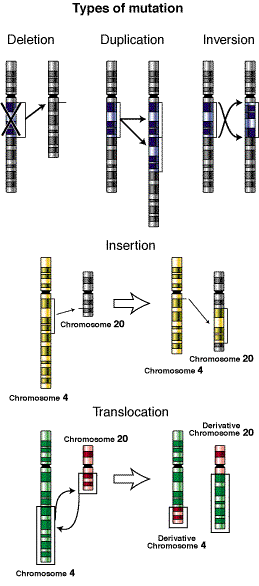
Deletion Mutation: A type of gene mutation wherein the deletion (as well as addition) of (a number of) nucleotide(s) causes a shift in the reading frame of the codons in the mRNA, thus, may eventually lead to the alteration in the amino acid sequence at protein translation

Insertion Mutation: A type of mutation resulting from the addition of extra nucleotides in a DNA sequence or chromosome. Insertion of a larger segment into the chromosome can also lead to mutation. It results when an unequal crossover happens during meiosis. 

Frameshift Mutation: A mutation seen when a number of DNA nucleotides not divisible by three is added or deleted. This causes a reading frame shift and all of the codons and all of the amino acids after that mutation are usually wrong. 

Point Mutation:  A mutation in DNA or RNA molecule involving a change of only one nucleotide base. It is a simple change in one base of the gene sequence.

Translocation Mutation: Translocations are the transfer of a piece of one chromosome to a nonhomologous chromosome. Translocations are often reciprocal; that is, the two nonhomologues swap segments. 

 references: http://www.biology-online.org http://users.rcn.com/jkimball.ma.ultranet/BiologyPages/M/Mutations.html http://www.genetichealth.com/g101_changes_in_dna.shtml